






Resource Center
Communication and sharing promote growth
Joining Hands for Development!
Communication and sharing promote growth
Joining Hands for Development!


Energy storage immersion liquid cooling technology is an advanced battery cooling method that uses the efficient thermal conductivity of liquid to achieve rapid, direct and sufficient cooling of the battery, ensuring that the battery operates in a safe and efficient environment. Its basic principle is to completely immerse the energy storage battery in an insulating, non-toxic liquid with heat dissipation capabilities. This technology uses direct contact between the liquid and the battery for heat exchange, thereby quickly absorbing the heat generated by the battery during charging and discharging, and bringing it to the external circulation system for cooling.
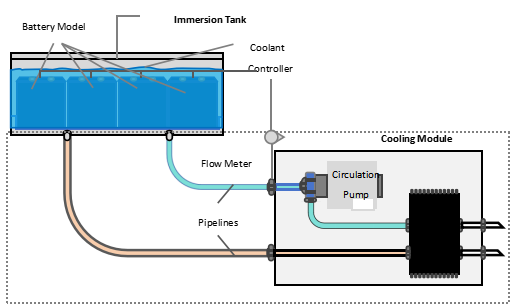
Schematic diagram of the principle of a single-phase immersion liquid cooling ESS(energy storage system)
As a key component for carrying the battery pack and ensuring that the battery cells work in a suitable environment, the Immersion Liquid Cooling ESS Battery Pack Enclosure mainly undertakes functions such as carrying the battery pack and coolant, safety protection, and heat conduction. Therefore, in the design of the battery pack enclosure structure, it is necessary to comprehensively consider multiple aspects such as airtightness, cooling efficiency, safety, material selection, and processing technology to ensure efficient, safe, and reliable operation of the system. The battery pack enclosure structure design is the basis of the entire liquid cooling system.
1-Unified load
The lower enclosure of the immersed liquid cooling energy storage pack is composed of a bottom plate and side plates. The bottom plate serves as a basic support, and the side plates are fixed around the bottom plate, which together form the main frame of the enclosure. The size of the battery pack enclosure should be adjusted taking into account the overall needs and load conditions of the liquid cooling system. In the design of larger-sized enclosures, internal partitions or support structures can be reasonably set up to divide the large space into multiple small spaces. force area to improve the uniform load-bearing capacity. In the internal structure, the local load-bearing capacity can be improved by adding support ribs and reinforcing ribs, and a load-sharing structure can also be set up inside the enclosure to balance the load at each corner.
At the same time, in order to reduce the impact of plastic deformation on uniform load-bearing, the processing surfaces of different heights can be designed as the same plane, which can reduce the number of machine tool adjustments and avoid deformation caused by height differences; the width or height of the enclosure can also be increased to disperse the load and reduce deformation.
In addition, the integrated design of the liquid cooling channel and the bottom plate of the enclosure is completed by stir friction welding or laser welding. This design can effectively improve the overall structural strength.
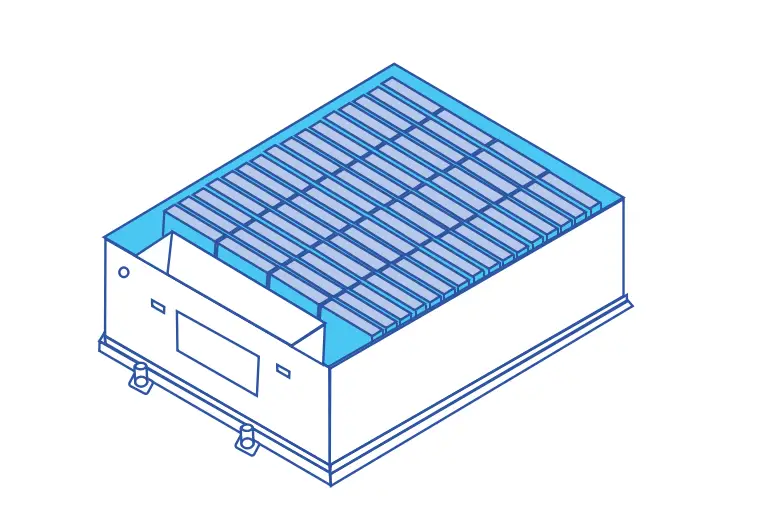
Schematic diagram of the lower box structure of a single-phase immersion liquid cooling energy storage pack
2-Heat exchange design
Thermal conductivity is an important part of immersion liquid cooling energy storage technology. The design goal is to ensure that the battery can effectively dissipate heat in a high temperature environment, thereby maintaining its performance and safety.
The material of the battery pack enclosure should have high thermal conductivity. Commonly used materials are aluminum alloy, copper, and aluminum-based composite materials. The enclosure design also needs to consider the impact of ambient temperature changes. The appropriate thickness of the insulation layer can ensure that the temperature inside the enclosure is within a relatively constant range, thereby improving the overall efficiency of the system.
The structural design of the enclosure directly affects its thermal conductivity. Reasonable flow channel layout ensures that the liquid flows smoothly inside the enclosure and maximizes the contact area, which is the main strategy to improve the thermal conductivity of the enclosure. Multiple flow channels can be set inside the enclosure to increase the coolant circulation path, thereby improving the heat dissipation effect.
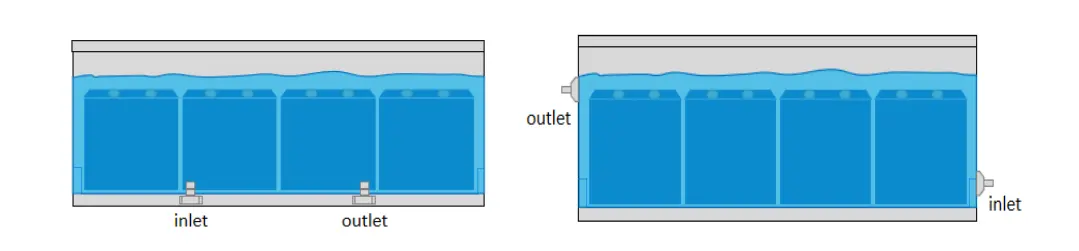
Solution 1: single item + plate replacement Solution 2: single item + enclosure replacement
The liquid cooling system includes a cooling medium, a heat-conducting structure, a liquid cooling pipeline and a supporting structure.
In the first scheme, the same or different types of coolants can be selected to be filled into the liquid cooling plate flow channel cavity and the enclosure cavity respectively, and the two cavities are sealed and not connected to each other. In the enclosure cavity, the coolant immerses the battery module, fully contacts it, cools it without flowing, and absorbs the heat on the battery surface by using the good thermal conductivity of the liquid to reduce the temperature rise. In the liquid cooling plate, the coolant is divided into multiple flow channels in the water inlet manifold and enters the cold plate in parallel, and then converges and flows out in the water outlet manifold, which is mainly responsible for taking out the heat and achieving heat dissipation.
In the second scheme, the coolant with low temperature flows in from the bottom or side, and the coolant with high temperature flows out from the top. The coolant circulates in the battery pack, which can effectively and evenly distribute the heat, improve the overall cooling efficiency, and maintain the consistency of the temperature of the battery cell or battery pack.
In order to further improve the cooling effect, a variety of optimization measures can be taken, such as optimizing the liquid flow and circulation method, selecting a coolant with high heat capacity, and improving the temperature distribution of the liquid. These measures reduce heat buildup and energy loss, ensuring the battery operates in an efficiently cooled state.
3-Sealed design
For liquid cooling battery pack enclosures, the fully sealed design is carried out by adopting advanced sealing materials and structures. The sealing design should not only consider air tightness, but also the sealing of liquid media to ensure that the battery cells are leak-free in all directions.
The design should select the appropriate sealing form and shape according to the specific application requirements, and also consider factors such as the leakage freedom, wear resistance, medium and temperature compatibility, and low friction of the seal, and select the appropriate seal type and material according to the detailed specifications.
In addition, the choice of welding process also has a great influence on the sealing performance. For different materials and thicknesses, choosing the appropriate welding method can effectively improve the quality of the weld to ensure the overall strength and sealing of the system.
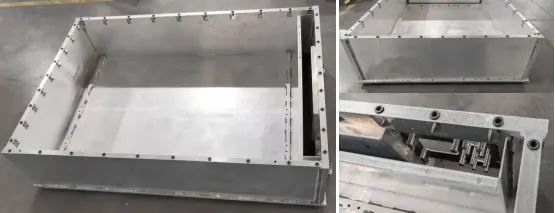
Finished picture of the enclosure of the single-phase immersion liquid cooling ESS battery pack enclosure
For more articles on immersion liquid cooling ESS(energy storage system), please read:Exploration, application and product iteration of immersion liquid cooling technology in the field of energy storage
We will regularly update you on technologies and information related to thermal design and lightweighting, sharing them for your reference.
Thank you for your attention to Walmate.
Scan to follow
测试测试测试测试测试测试测试测试测试测试测试测试测试测试测试测试测试测试测试测试测试测试测试测试测试测试测试测试测试测试测试测试测试测试测试测试测试测试测试测试测试测试测试测试测试测试测试测试测试测试测试测试测试测试测试测试测试测试测试
测试测试测试测试测试测试测试测试测试测试测试测试测试测试测试测试测试测试测试测试测试测试测试测试测试测试测试测试测试测试测试测试测试测试测试测试测试测试测试测试测试测试测试测试测试测试测试测试测试测试测试测试测试测试测试测试测试测试测试
测试测试测试测试测试测试测试测试测试测试测试测试测试测试测试测试测试测试测试测试测试测试测试测试测试测试测试测试测试测试测试测试测试测试测试测试测试测试测试测试测试测试测试测试测试测试测试测试测试测试测试测试测试测试测试测试测试测试测试
测试测试测试测试测试测试测试测试测试测试测试测试测试测试测试测试测试测试测试测试测试测试测试测试测试测试测试测试测试测试测试测试测试测试测试测试测试测试测试测试测试测试测试测试测试测试测试测试测试测试测试测试测试测试测试测试测试测试测试
测试测试测试测试测试测试测试测试测试测试测试测试测试测试测试测试测试测试测试测试测试测试测试测试测试测试测试测试测试测试测试测试测试测试测试测试测试测试测试测试测试测试测试测试测试测试测试测试测试测试测试测试测试测试测试测试测试测试测试
测试测试测试测试测试测试测试测试测试测试测试测试测试测试测试测试测试测试测试测试测试测试测试测试测试测试测试测试测试测试测试测试测试测试测试测试测试测试测试测试测试测试测试测试测试测试测试测试测试测试测试测试测试测试测试测试测试测试测试
测试测试测试测试测试测试测试测试测试测试测试测试测试测试测试测试测试测试测试测试测试测试测试测试测试测试测试测试测试测试测试测试测试测试测试测试测试测试测试测试测试测试测试测试测试测试测试测试测试测试测试测试测试测试测试测试测试测试测试
测试测试测试测试测试测试测试测试测试测试测试测试测试测试测试测试测试测试测试测试测试测试测试测试测试测试测试测试测试测试测试测试测试测试测试测试测试测试测试测试测试测试测试测试测试测试测试测试测试测试测试测试测试测试测试测试测试测试测试
测试测试测试测试测试测试测试测试测试测试测试测试测试测试测试测试测试测试测试测试测试测试测试测试测试测试测试测试测试测试测试测试测试测试测试测试测试测试测试测试测试测试测试测试测试测试测试测试测试测试测试测试测试测试测试测试测试测试测试
测试测试测试测试测试测试测试测试测试测试测试测试测试测试测试测试测试测试测试测试测试测试测试测试测试测试测试测试测试测试测试测试测试测试测试测试测试测试测试测试测试测试测试测试测试测试测试测试测试测试测试测试测试测试测试测试测试测试测试
测试测试测试测试测试测试测试测试测试测试测试测试测试测试测试测试测试测试测试测试测试测试测试测试测试测试测试测试测试测试测试测试测试测试测试测试测试测试测试测试测试测试测试测试测试测试测试测试测试测试测试测试测试测试测试测试测试测试测试
测试测试测试测试测试测试测试测试测试测试测试测试测试测试测试测试测试测试测试测试测试测试测试测试测试测试测试测试测试测试测试测试测试测试测试测试测试测试测试测试测试测试测试测试测试测试测试测试测试测试测试测试测试测试测试测试测试测试测试
测试测试测试测试测试测试测试测试测试测试测试测试测试测试测试测试测试测试测试测试测试测试测试测试测试测试测试测试测试测试测试测试测试测试测试测试测试测试测试测试测试测试测试测试测试测试测试测试测试测试测试测试测试测试测试测试测试测试测试
测试测试测试测试测试测试测试测试测试测试测试测试测试测试测试测试测试测试测试测试测试测试测试测试测试测试测试测试测试测试测试测试测试测试测试测试测试测试测试测试测试测试测试测试测试测试测试测试测试测试测试测试测试测试测试测试测试测试测试
测试测试测试测试测试测试测试测试测试测试测试测试测试测试测试测试测试测试测试测试测试测试测试测试测试测试测试测试测试测试测试测试测试测试测试测试测试测试测试测试测试测试测试测试测试测试测试测试测试测试测试测试测试测试测试测试测试测试测试
测试测试测试测试测试测试测试测试测试测试测试测试测试测试测试测试测试测试测试测试测试测试测试测试测试测试测试测试测试测试测试测试测试测试测试测试测试测试测试测试测试测试测试测试测试测试测试测试测试测试测试测试测试测试测试测试测试测试测试
测试测试测试测试测试测试测试测试测试测试测试测试测试测试测试测试测试测试测试测试测试测试测试测试测试测试测试测试测试测试测试测试测试测试测试测试测试测试测试测试测试测试测试测试测试测试测试测试测试测试测试测试测试测试测试测试测试测试测试
测试测试测试测试测试测试测试测试测试测试测试测试测试测试测试测试测试测试测试测试测试测试测试测试测试测试测试测试测试测试测试测试测试测试测试测试测试测试测试测试测试测试测试测试测试测试测试测试测试测试测试测试测试测试测试测试测试测试测试
测试测试测试测试测试测试测试测试测试测试测试测试测试测试测试测试测试测试测试测试测试测试测试测试测试测试测试测试测试测试测试测试测试测试测试测试测试测试测试测试测试测试测试测试测试测试测试测试测试测试测试测试测试测试测试测试测试测试测试
测试测试测试测试测试测试测试测试测试测试测试测试测试测试测试测试测试测试测试测试测试测试测试测试测试测试测试测试测试测试测试测试测试测试测试测试测试测试测试测试测试测试测试测试测试测试测试测试测试测试测试测试测试测试测试测试测试测试测试


